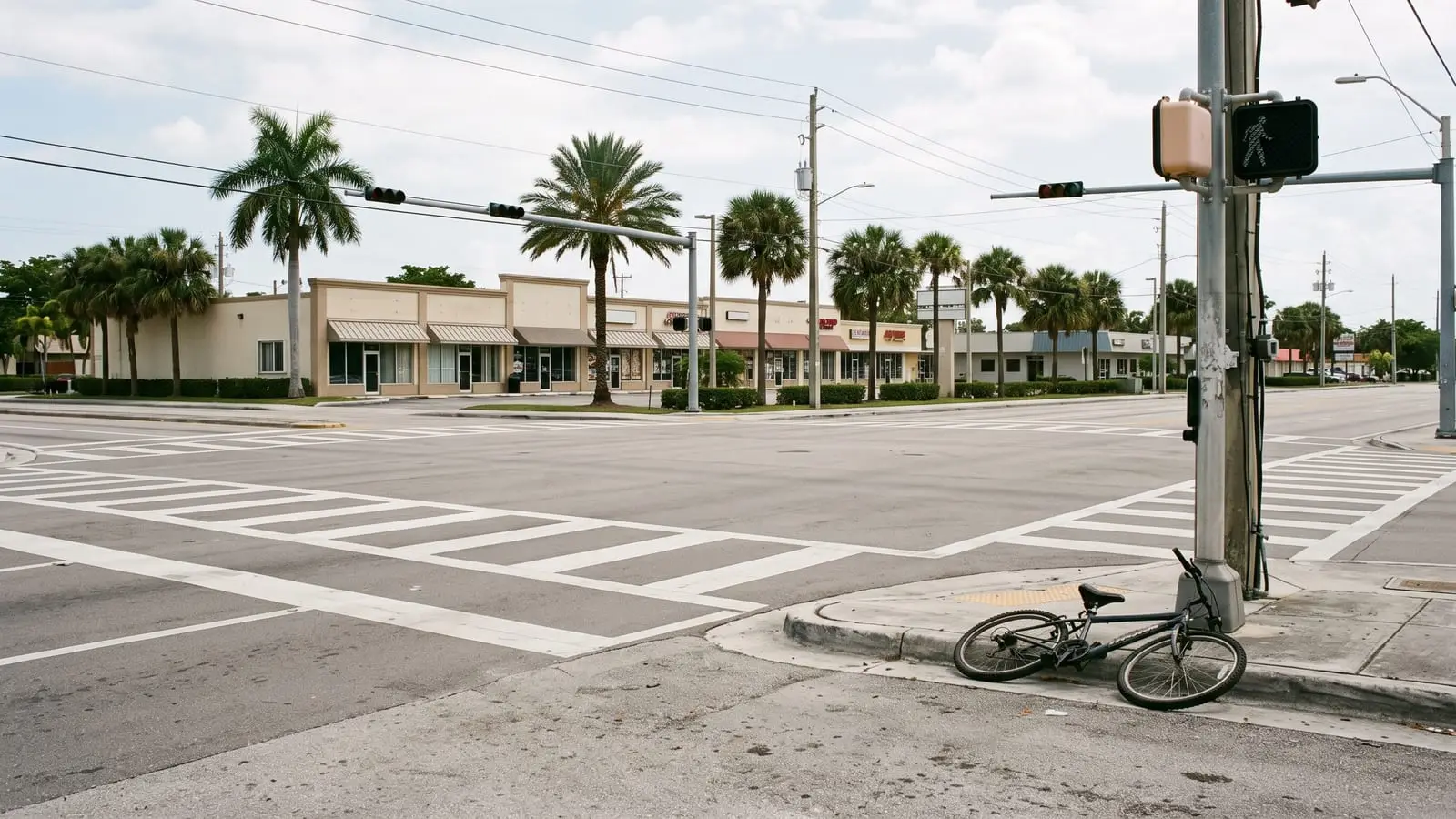
I was hit by a car on foot or on a bike in Fort Lauderdale. Who pays?
When a driver strikes you while you are walking or riding a bicycle in Fort Lauderdale, your first medical bills are usually paid by PIP, Florida's no-fault coverage, even though you were not in a vehicle, and the rest of the claim goes against the driver's insurance. PIP pays up to $10,000: from your own policy if you own an insured car, from a relative's if you live with one who has it, and otherwise from the policy on the car that hit you (Fla. Stat. § 627.736(4)(e)).
The driver also had legal duties toward you. Florida requires drivers to yield to people in a crosswalk (Fla. Stat. § 316.130) and to leave at least three feet when passing someone on a bicycle (Fla. Stat. § 316.083). Wolfson & Leon has represented people hurt on foot and on bikes since 1963, from an office in the Las Olas area of downtown Fort Lauderdale. The consultation is free, in English or Spanish, and you pay no fee unless the firm recovers money for you.
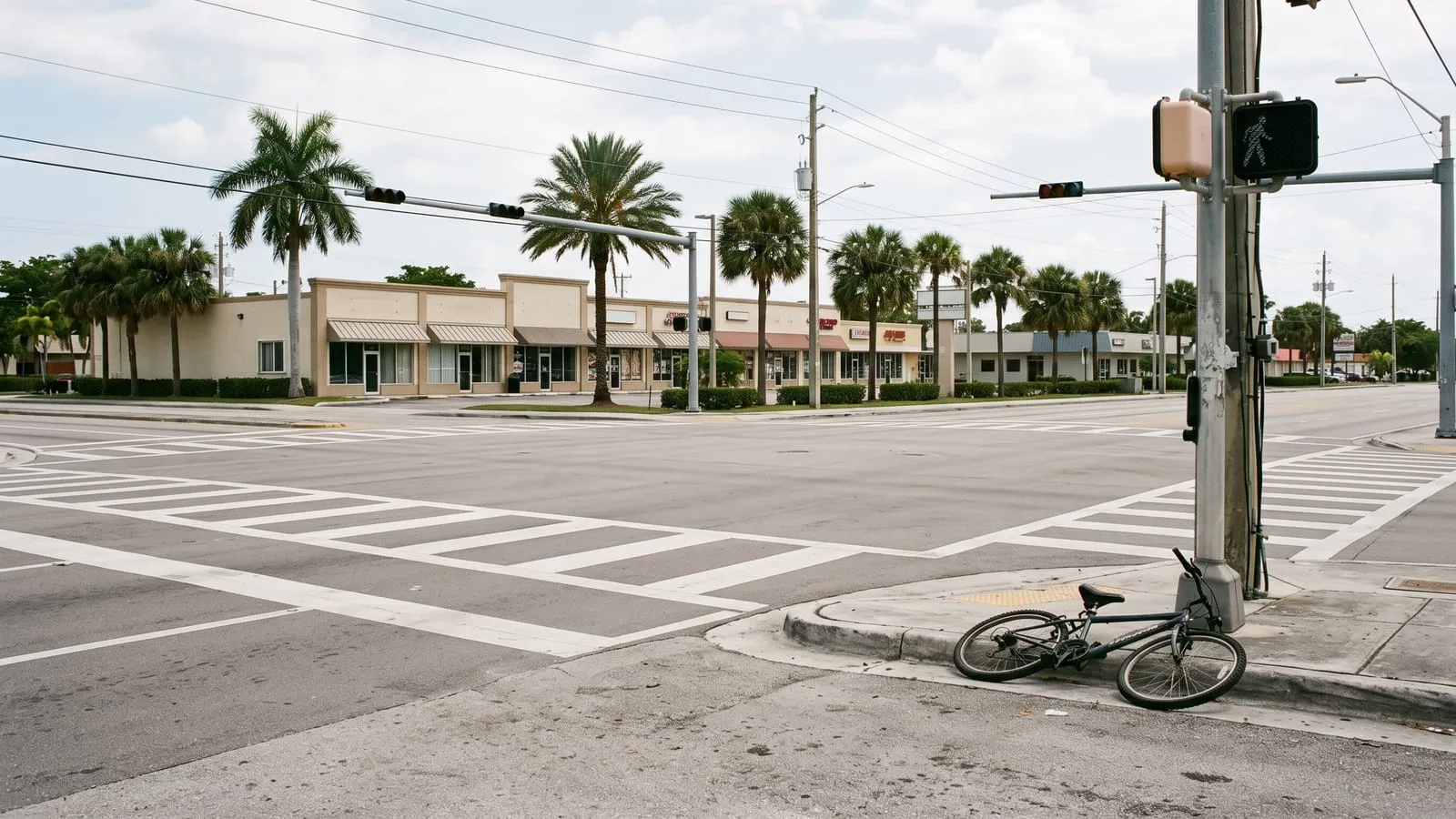
Where are people on foot and on bikes most exposed in Fort Lauderdale?
Some of the busiest walking areas in Broward sit right next to fast, wide roads. Along SR A1A on Fort Lauderdale Beach, visitors cross between hotels and the sand all day, often looking at the ocean instead of the traffic, while drivers in rental cars from FLL look for parking. On Las Olas Blvd, diners spill onto the sidewalks at night. US 1 / Federal Highway, Broward Blvd and Sunrise Blvd carry heavy traffic past bus stops and shopping centers. The 17th Street Causeway links the beach, the Intracoastal and Port Everglades, and drawbridges over the New River and the Intracoastal stop and release traffic in bursts. In winter, snowbird and tourist season adds drivers who do not know the streets.
Downtown adds one more hazard: the Florida East Coast tracks, where Brightline trains cross many streets. We cover rail crossings below.
Who covers the hospital bills when I was not in a car?
Florida's no-fault system does not stop at people inside vehicles. The order is: PIP first, then your health insurance, then the driver's bodily injury coverage. For PIP, look in this order: your own policy if you own an insured car; a policy belonging to a relative you live with; and if neither exists, the policy on the vehicle that struck you.
Treatment must start within 14 days of the crash for PIP to pay. Serious pedestrian and bicycle injuries in Broward are often taken to Broward Health Medical Center on S Andrews Ave or Memorial Regional Hospital in Hollywood, both Level I trauma centers; for lesser injuries, any urgent care counts. When PIP runs out, the driver's bodily injury insurance and any uninsured motorist coverage in your household pay for lost wages, future care, and, for a permanent injury, pain and suffering.
I crossed in the middle of the block. Do I lose my claim?
No. Florida uses comparative fault (Fla. Stat. § 768.81): if you share some blame, your recovery shrinks by that share, and it is barred only if you were more than half at fault. Crossing outside a crosswalk does not erase the driver's own duties. Every driver must use due care to avoid hitting a pedestrian and must sound the horn when it is needed (Fla. Stat. § 316.130(15)).
On a long stretch of A1A or Federal Highway, the nearest signal can be far away, and people cross where they need to. A jury can weigh that against a driver who was speeding, texting, or simply not looking. The line in the crash report that says you were not in a crosswalk is one officer's view, not a decision about who pays.
What are my rights as a cyclist on Broward roads?
Under Florida law a bicycle is a vehicle, and the person riding it has the same rights and duties as any driver (Fla. Stat. § 316.2065). That matters on beach roads, on Las Olas, and on the bridges, where drivers tend to treat cyclists as obstacles.
- Three feet. A driver passing you must leave at least three feet of space (Fla. Stat. § 316.083(1)).
- Sidewalks. You may ride on the sidewalk unless a local ordinance says otherwise, but you must yield to people walking there.
- Helmets. Riders under 16 must wear one. Adults are not required to wear one.
- Same PIP access. A cyclist hit by a car can use PIP in the same order as a pedestrian.
- Doors and right hooks. A driver who opens a door into your path or turns right across you is a common defendant. Rideshare drop-offs on busy streets are a frequent source of dooring; see our page on rideshare accidents.
What if it happened at a railroad crossing downtown?
Brightline runs passenger trains on the Florida East Coast tracks through downtown Fort Lauderdale, across many street crossings, and Tri-Rail runs on the western tracks. A crash at or near a crossing can involve a motorist, the rail operator, and whoever is responsible for the gates, signals and walkway at that crossing. Brightline is a private company. Tri-Rail and other public operators are government bodies, and claims against a public body follow the written-notice rules described in the FAQ below. These cases depend on records the operator controls, so they need to be requested quickly.
The driver did not stop. How do I find them, and who pays if I can't?
Leaving the scene of a crash that injures someone is a felony in Florida (Fla. Stat. § 316.027). Call the police from the scene if you can: the Fort Lauderdale Police Department inside city limits, or the Broward Sheriff's Office or your city's police department elsewhere in the county. Write down the case number.
Video is the best way to find the car. Hotels along the beach, the shops and restaurants on Las Olas, and garages and storefronts downtown usually have cameras, but they record over the footage. Wolfson & Leon sends written preservation requests to nearby businesses and works from the police report to identify the vehicle. If the driver is never found, uninsured motorist coverage, yours or a resident relative's, treats the hit-and-run driver as uninsured and can pay the claim.
What can I recover after being struck on foot or on a bike?
PIP covers the first $10,000 of medical bills and lost income, paid from your policy, a resident relative's, or the striking vehicle's (Fla. Stat. § 627.736(4)(e)). Beyond PIP, a pedestrian or cyclist can recover medical expenses, lost wages, and, for a permanent injury, pain and suffering, from the driver's bodily injury insurance and from uninsured motorist coverage in your household. People on foot rarely walk away from a car with minor injuries, and the driver may carry little or no bodily injury coverage. Finding every policy that could apply, early, is often what decides how much is actually available.
Which mistakes hurt a pedestrian or bicycle claim?
- Treating the crash report as the final word on fault. It is an officer's note, and comparative fault only reduces a recovery unless you were more than half to blame.
- Waiting to look for video. Beachfront hotels, Las Olas storefronts and downtown garages record over their footage; buses and traffic systems may keep it for even less time.
- Skipping the doctor because you could stand up. PIP's 14-day rule applies to pedestrians and cyclists too.
- Talking to the driver's insurer early. Wait until your lawyer has the report and the scene photos.
- Not reporting a hit-and-run to police within 24 hours. Many uninsured motorist policies require a prompt report.
- Repairing or throwing away the bike. The damage shows the angle and force of the impact. Keep it as it is, along with your helmet and clothing.
Key facts
- Someone on foot or on a bike who owns no car is covered by the PIP on the vehicle that hit them. Source: Fla. Stat. § 627.736(4)(e)
- Drivers must yield to pedestrians in crosswalks and use due care to avoid any pedestrian. Source: Fla. Stat. § 316.130
- A driver passing a bicycle must leave at least three feet. Source: Fla. Stat. § 316.083(1)
- On Florida roads, a bicycle is a vehicle, and its rider has a driver's rights and duties. Source: Fla. Stat. § 316.2065
- Leaving the scene of an injury crash is a felony. Source: Fla. Stat. § 316.027
- For crashes on or after March 24, 2023, a negligence lawsuit must be filed within two years. Source: Fla. Stat. § 95.11
Frequently asked questions
I'm a visitor and got hit crossing A1A. Can I pursue this after I go home?
Yes. The crash happened in Florida, so Florida law applies wherever you live. Get examined before you leave, keep every bill and record, and photograph your injuries. The firm can handle much of the case by phone and email once you are home.
A car backing out of a parking space or a garage hit me. Is that different?
The same rules apply in a parking lot or garage as on the street: the driver has to watch for people on foot. Supermarket lots, mall lots such as the Galleria at Fort Lauderdale or Sawgrass Mills, and downtown garages have cameras, and the property owner may also be responsible if poor lighting or layout played a part. We ask for that footage right away.
A Broward County Transit bus or a city truck hit me. Can I still make a claim?
Yes, but the rules are stricter. Before suing a city, the county, the school board, or another public body, you must give written notice to the agency (Fla. Stat. § 768.28(6)), and the amount you can recover is capped by statute unless the Legislature passes a claims bill. Do not wait on these cases.
My child was hit near home or school. Who brings the claim?
A parent or guardian brings it for the child. A jury judges a child by what is reasonable for a child of that age, not by adult standards. Settlements for a minor above certain amounts need a judge's approval under Fla. Stat. § 744.387, and the firm handles that step.
The driver's insurer called me in the hospital. What should I say?
As little as possible until you have a lawyer. Give your name and contact information if asked, and do not describe the crash or your injuries in a recorded call. Early statements made on pain medication are often used later to shift blame.
What happens when you call
Someone at the firm picks up
Call (754) 305-0820 day or night and you reach a member of the team, who can speak with you in Spanish if that is easier. After hours, we take your name and number and an attorney calls you back that morning.
A short conversation about the accident
We will ask for the date and place, whether a doctor has seen you, whether police wrote a report, and whether an insurance company has contacted you. It usually takes a quarter of an hour, and you do not need to find any documents first.
A straight answer, even if it is not the one you hoped for
If your case is one we can take, we walk you through what comes next and what to avoid for now, such as giving a recorded statement. If it is not, we say so plainly and point you to someone who may help.
Nothing to pay up front
If you decide to work with us, the fee is a percentage of whatever is recovered, set out in writing before you sign. No recovery means no fee. If you cannot get to downtown Fort Lauderdale, we come to your home or the hospital.