
Who pays after a car crash in Fort Lauderdale, and what should I do first?
After a car crash in Fort Lauderdale, your own Personal Injury Protection (PIP) coverage pays the first medical bills no matter who caused the wreck, but only if a doctor, hospital, or urgent care treats you within 14 days. The first moves are to get that care, write down the crash report number, and hold off on any recorded statement to the other driver’s insurer until a lawyer has looked at your situation. PIP stops at $10,000 under Fla. Stat. § 627.736, so the rest of your losses, including pain and suffering, has to come from the at-fault driver’s insurance or from your own uninsured motorist coverage, and pain and suffering is available only for an injury that clears Florida’s permanent-injury bar.
Wolfson & Leon has represented injured people in South Florida since 1963. Its Fort Lauderdale office is in the 110 Tower downtown, roughly a block from the Broward County Courthouse. The consultation is free, in English or Spanish, the phones are answered 24/7, and you pay no fee unless the firm recovers money for you.
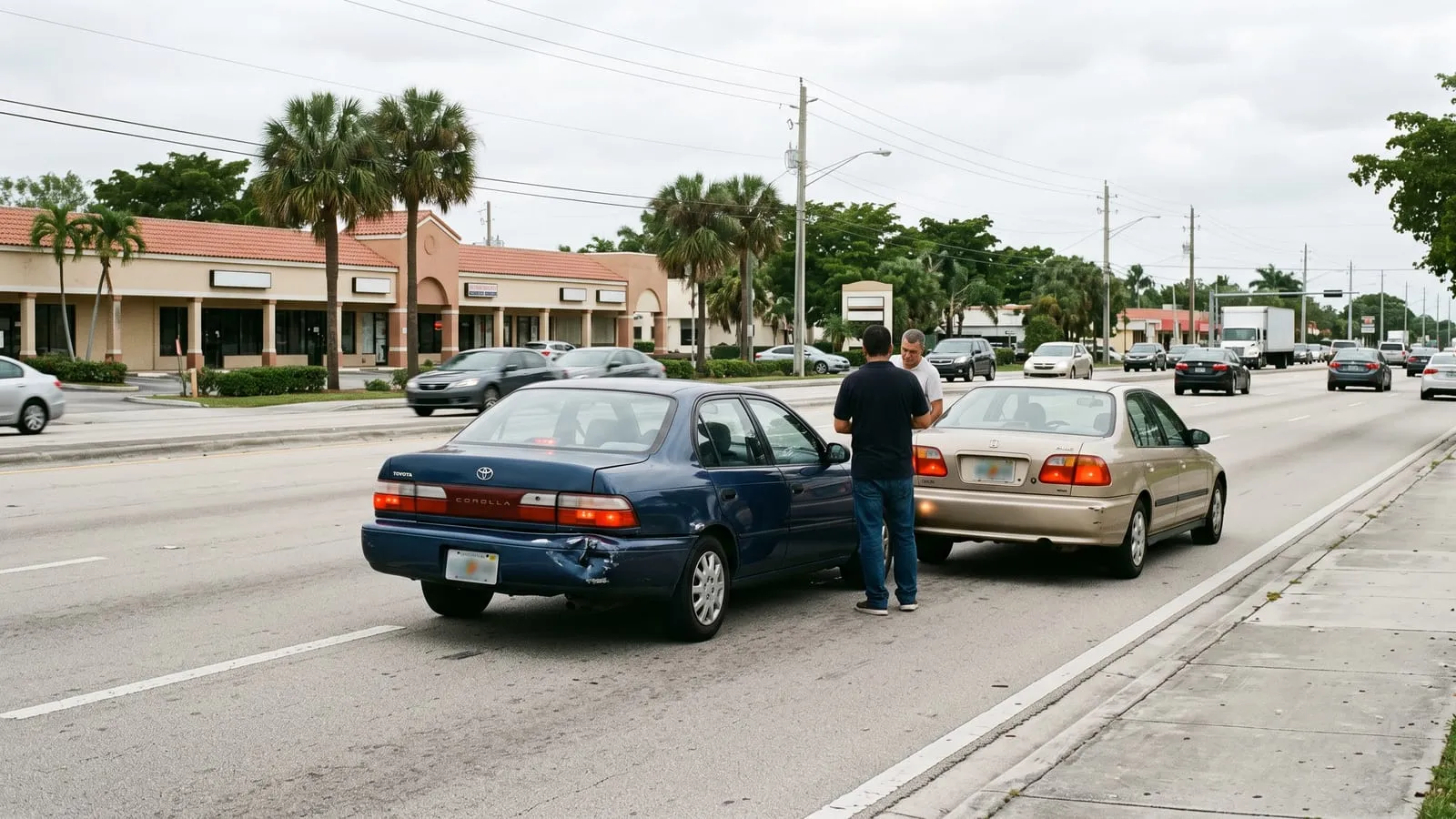
Which insurance covers which bill after a Broward County crash?
Think of the money as layers that get used in order. Knowing the order explains why an adjuster says one thing in week one and something different in month six.
- Layer one is your own PIP, fault does not matter. Every car registered in Florida has to carry $10,000 of it. It covers 80% of reasonable medical charges and 60% of the income you lose while you are hurt. If no treating doctor documents an “emergency medical condition,” the medical side is limited to $2,500 (Fla. Stat. § 627.736(1)).
- Layer two is health insurance and providers who agree to wait. Once PIP runs out, your health plan can pick up treatment, and some doctors will treat now and be paid from the settlement later.
- Layer three is the at-fault driver’s bodily injury liability policy. It pays at the end of the claim, and only if the injury qualifies as permanent. Florida does not make most drivers buy this coverage at all (Fla. Stat. § 324.022, § 627.733), so plenty of cars on I-95 have none.
- Layer four is your own uninsured motorist (UM) coverage. When the other driver has no bodily injury coverage, or too little, UM on your policy or on a policy of a relative you live with often becomes the real source of recovery.
What should I actually do this week?
Most of what protects a claim happens in the first several days, and most of it is simple. Here is the short version for a crash anywhere in Broward.
- See a doctor before the 14-day PIP window closes (Fla. Stat. § 627.736(1)(a)), even if the soreness seems minor. Whiplash and concussion symptoms commonly build over a day or two. Broward Health Medical Center on S Andrews Ave and Memorial Regional Hospital in Hollywood are Level I trauma centers; Holy Cross, Imperial Point, Broward Health North, Memorial Hospital West, and Cleveland Clinic Florida in Weston are also nearby, and any urgent care counts for PIP.
- Find out which agency wrote the report. Inside city limits it is usually the Fort Lauderdale Police Department. In unincorporated Broward and in cities that contract for policing, it is the Broward Sheriff’s Office. Hollywood, Plantation, Coral Springs, Pembroke Pines, and other cities have their own departments, and on I-95, I-595, Florida’s Turnpike, and the Sawgrass Expressway it is normally the Florida Highway Patrol. Reports generally post to the Florida Crash Portal within about 10 days.
- Save what will vanish. Photograph both cars, the road, your injuries, and the other driver’s license, plate, and insurance card. Note any storefront, condo, or hotel cameras nearby, because many recording systems write over themselves within weeks. Back the photos up off your phone.
- Keep calls with the other driver’s insurer short. Give your name and contact details, then say your lawyer will follow up. Your own carrier is owed cooperation, but it still helps to know your rights before that conversation.
I was in town on vacation, or driving a rental from FLL. Does that change anything?
Fort Lauderdale has far more visitors than most cities its size: cruise passengers heading to Port Everglades, travelers picking up rental cars at the airport, and seasonal residents who spend the winter here and the summer up north. An injury in a Broward crash can still be the basis of a Florida claim even if you live somewhere else, and Wolfson & Leon can handle much of the work by phone and email after you go home.
Visitor cases do raise questions a local case may not. Whose PIP applies depends on your own policy and on the car you were in. A rental can involve your home auto policy, coverage purchased at the counter, and the rental company’s own coverage, and the rental agreement has to be read to sort out which pays. If you were a passenger or on foot and do not own a car yourself, the PIP on the vehicle involved usually covers you (Fla. Stat. § 627.736(4)(e)).
The practical risk for visitors is time. People fly home before seeing a doctor, before getting a report number, and before anyone photographs the cars. If you can, get checked in Broward before you leave.
When can I claim pain and suffering, not just my bills?
Florida only lets you recover pain, suffering, and similar losses from the driver who caused the crash if the injury crosses a line set in Fla. Stat. § 627.737(2). The statute lists four ways to cross it: a significant and permanent loss of an important bodily function; a permanent injury, stated within a reasonable degree of medical probability; significant and permanent scarring or disfigurement; or death. In practice, fractures, herniated discs, and injuries that end in surgery often qualify. A muscle strain that heals completely usually does not, which is why the medical records matter so much.
Fault is shared on a sliding scale. Under Fla. Stat. § 768.81(6), if a jury puts more than half the blame on you, you get nothing from the other driver. At 50% or less, your award shrinks by your share, so being 20% responsible for a lane change on Sunrise Blvd means recovering 80%, not zero.
How long do I have, and what if a bus or city vehicle hit me?
For crashes on or after March 24, 2023, a Florida negligence lawsuit generally has to be filed within two years of the crash date (Fla. Stat. § 95.11). Older crashes had four years. Insurance claims should be opened long before either deadline, and PIP keeps its own 14-day treatment rule.
A government vehicle adds a step. If you were hit by a Broward County Transit bus, a City of Fort Lauderdale truck, a Broward County Public Schools bus, or a BSO patrol car, written notice of the claim has to be given under Fla. Stat. § 768.28(6) before suit can be filed, and the process runs slower than an ordinary claim. Brightline, by contrast, is a private company, so a crash at one of its downtown street crossings is handled as a claim against a private party.
Where do Broward car crashes tend to happen?
The same patterns come up again and again in Fort Lauderdale-area cases. The I-95/I-595 interchange forces fast merges and lane changes, and I-595 also feeds traffic toward the airport and the port. Florida’s Turnpike and the Sawgrass Expressway carry high-speed commuter traffic in the western suburbs. Along Fort Lauderdale Beach, A1A mixes drivers looking for parking with people crossing on foot. Inland, the busy east-west corridors include Broward Blvd, Sunrise Blvd, Oakland Park Blvd, Commercial Blvd, and State Road 84, while US 1 / Federal Highway, Andrews Ave, University Drive, and State Road 7 / US 441 run north and south.
Two local features cause a steady stream of rear-end crashes: drawbridges over the New River and the Intracoastal, where traffic stops suddenly when a span opens, and the winter season, when snowbirds and tourists who do not know the roads slow, turn, or brake unexpectedly. The exact location matters for the evidence, from which agency took the report to which cameras might have caught the collision.
Besides medical bills, what can a Broward car accident claim pay for?
A claim against the driver who caused the crash can include economic losses: medical treatment already received and treatment you will need later, income you lost, and any reduction in your ability to earn going forward. If the at-fault driver’s coverage falls short, your own uninsured motorist coverage can fill part of the gap. When the injury meets the permanent-injury standard in Fla. Stat. § 627.737, the claim can also include non-economic losses such as pain, mental suffering, inconvenience, and the loss of things you used to enjoy, whether that is surfing off the beach or simply sleeping through the night.
Damage to the car itself is a separate claim, paid by the other driver’s property damage coverage or by your own collision coverage. Nobody can honestly put a figure on a case at the first call. What sets the value is the injury, the treatment, who was at fault, and how much insurance exists, and Wolfson & Leon will tell you plainly which of those is the limit in your case.
What quietly shrinks a car accident claim?
Most claims are not lost in a courtroom. They lose value in small ways in the weeks after the crash.
- Letting the 14-day window pass. You lose PIP, and the insurer gets to argue that someone truly hurt would have seen a doctor.
- Flying home before getting checked. Visitors and snowbirds who leave Broward without a medical visit or a report number create gaps that are hard to close later.
- Talking on a recorded line in the first few days, before you know your diagnosis or have read the crash report.
- Posting beach photos, gym check-ins, or crash updates online. Adjusters search social media, and one picture can be framed as proof you were fine.
- Skipping therapy appointments. A month without treatment gets read as a month of recovery, whether you were better or not.
- Signing an open-ended medical release that lets the insurer collect your full medical history instead of the records tied to the crash.
- Taking a quick settlement while you are still being treated. A signed release ends the claim, even if you later learn you need surgery.
Key facts
- PIP medical benefits require treatment within 14 days after the crash. Source: Fla. Stat. § 627.736(1)(a)
- PIP covers 80% of reasonable medical charges and 60% of lost income up to $10,000, with medical benefits capped at $2,500 unless an emergency medical condition is documented. Source: Fla. Stat. § 627.736(1)
- Recovering pain and suffering from the at-fault driver requires a permanent injury, significant permanent scarring or disfigurement, or death. Source: Fla. Stat. § 627.737(2)
- A person found more than 50% responsible for the crash cannot recover damages from the other driver. Source: Fla. Stat. § 768.81(6)
- Negligence suits over crashes on or after March 24, 2023 generally must be filed within two years. Source: Fla. Stat. § 95.11
- Most Florida drivers are required to carry only $10,000 of PIP and $10,000 of property damage liability, with no bodily injury coverage required. Source: Fla. Stat. § 324.022, § 627.733
Frequently asked questions
My crash was on I-595. Why did a state trooper take the report instead of Fort Lauderdale police?
The Florida Highway Patrol normally handles crashes on the interstates and toll highways in Broward, including I-95, I-595, Florida’s Turnpike, and the Sawgrass Expressway. City police and BSO handle surface streets in their areas. Whichever agency wrote it, the report is usually available through the Florida Crash Portal within about 10 days, and Wolfson & Leon can pull it for you.
I live up north part of the year. Can I still pursue a claim for a Broward crash?
Yes. Where you live does not decide whether you can bring a Florida claim for a Florida crash. Many seasonal residents and visitors handle most of the case from home by phone and email, and if a lawsuit is needed it is often filed in Broward, at the courthouse about a block from our office.
The other driver’s adjuster wants a recorded statement. Am I required to give one?
No. You owe a recorded statement to nobody on the other side of the claim, and those calls are designed to lock you into details before you know the extent of your injuries. Write down the adjuster’s name and claim number and let your lawyer return the call.
The report says I was partly to blame. Is my claim finished?
Not necessarily. If you were 50% or less at fault, you can still recover, reduced by your share (Fla. Stat. § 768.81). Only above 50% is recovery from the other driver barred. The officer’s opinion in the report is not binding, and witnesses, video, and vehicle damage often tell a different story.
I don’t own a car. Will PIP still pay my medical bills?
Often it will. A passenger or pedestrian without a car of their own is usually covered by the PIP on the vehicle involved (Fla. Stat. § 627.736(4)(e)), and a policy owned by a relative you live with may apply too. The answer depends on the details, so bring them up on the call.
What will it cost me to hire Wolfson & Leon?
Nothing up front. The firm works on a contingency fee, which means its fee is a percentage of the money recovered, and if nothing is recovered you owe no fee. Wolfson & Leon also advances the costs of the case. The percentage is spelled out in writing before you sign.
What happens when you call
Someone at the firm picks up
Call (754) 305-0820 day or night and you reach a member of the team, who can speak with you in Spanish if that is easier. After hours, we take your name and number and an attorney calls you back that morning.
A short conversation about the accident
We will ask for the date and place, whether a doctor has seen you, whether police wrote a report, and whether an insurance company has contacted you. It usually takes a quarter of an hour, and you do not need to find any documents first.
A straight answer, even if it is not the one you hoped for
If your case is one we can take, we walk you through what comes next and what to avoid for now, such as giving a recorded statement. If it is not, we say so plainly and point you to someone who may help.
Nothing to pay up front
If you decide to work with us, the fee is a percentage of whatever is recovered, set out in writing before you sign. No recovery means no fee. If you cannot get to downtown Fort Lauderdale, we come to your home or the hospital.
Related articles
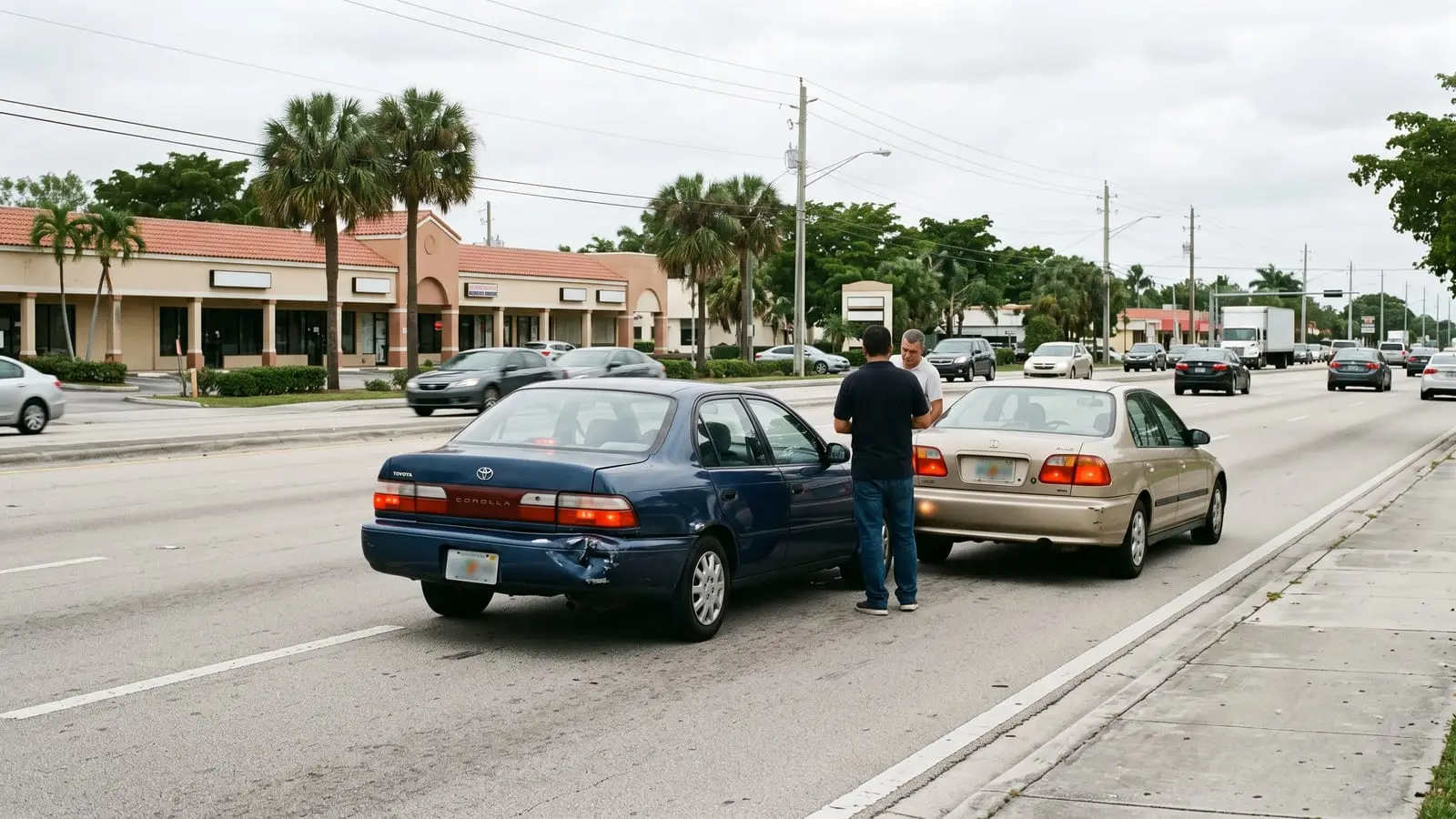 Car accidents
Visiting Fort Lauderdale and hurt in a rental car crash: which insurance pays, and can you handle the case from home?
Yes. A crash in Fort Lauderdale or anywhere in Broward is generally handled under Florida law even if you live in another state or country, and much…
Car accidents Crashed on I-95 or I-595 in Broward? What to do, and which agency writes your crash report
After a crash on I-95 or I-595 in Broward County, the Florida Highway Patrol (FHP) usually responds and writes the report, as it does on Florida's…