
A semi or delivery truck hit me in Fort Lauderdale. Who is responsible?
Usually more than one party. After a truck crash in Fort Lauderdale, responsibility can extend past the driver to the motor carrier operating the truck, the company that owns the tractor or trailer, whoever loaded the cargo, and whoever maintained the brakes, and each of them tends to have its own insurance policy. Those companies operate under federal safety rules (49 C.F.R. Parts 390–399), interstate general-freight carriers must carry at least $750,000 in liability coverage, and the driver logs, camera footage, and electronic data that show what happened can be overwritten within days unless someone demands in writing that they be kept.
Wolfson & Leon has represented people hurt by commercial vehicles in South Florida since 1963, from its office in downtown Fort Lauderdale near the Broward County Courthouse. The consultation is free, in English or Spanish, the phones are answered 24/7, and you pay no fee unless the firm recovers money for you.
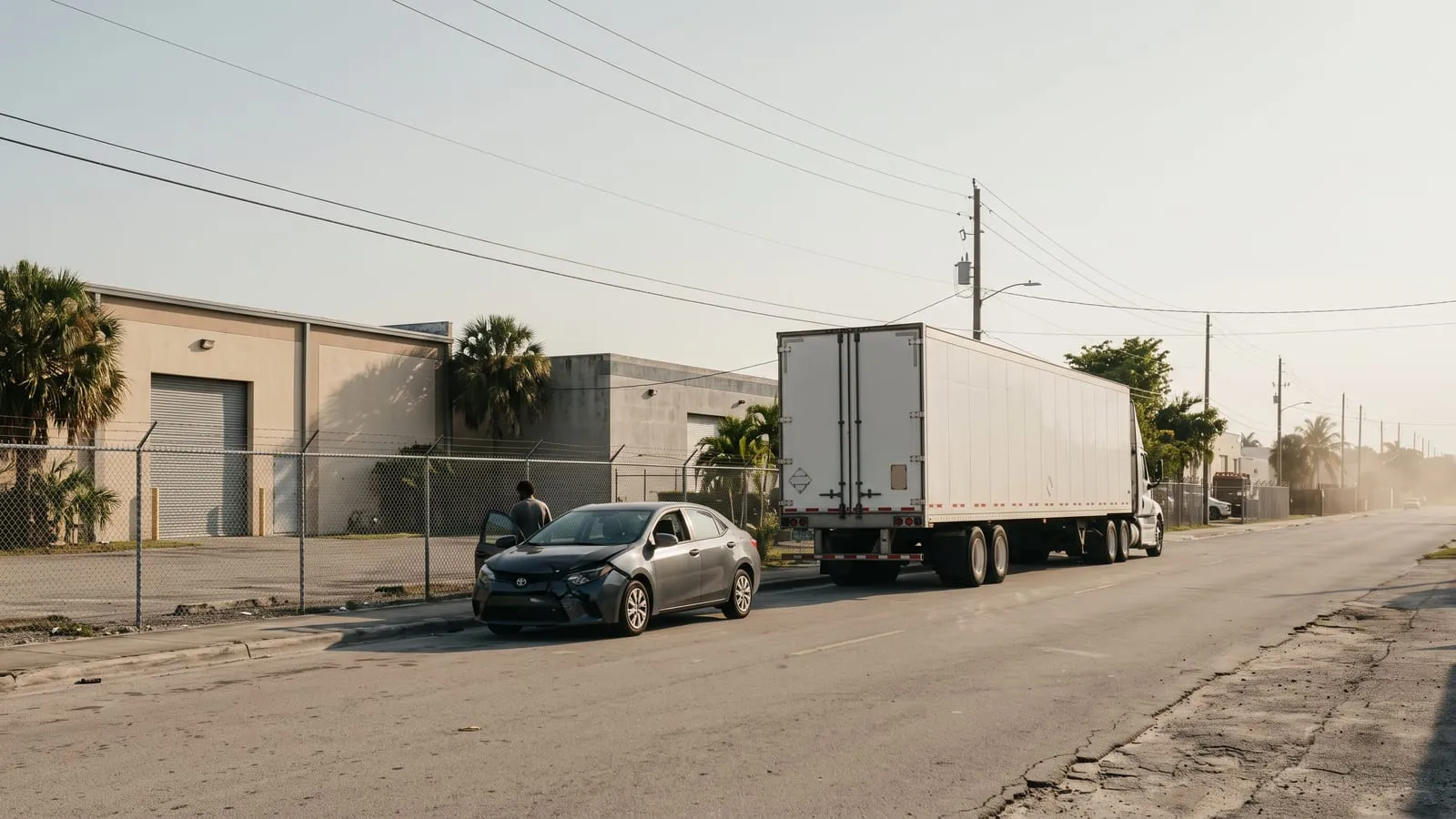
Why do so many Broward truck crashes involve I-595 and the port?
Port Everglades is both a cruise port and a cargo port, sitting where Fort Lauderdale, Hollywood, and Dania Beach meet, with Fort Lauderdale-Hollywood International Airport right beside it. Freight moving in and out of the port rides I-595 and State Road 84, then spreads out onto I-95, Florida’s Turnpike, and the Sawgrass Expressway. That puts tractor-trailers in the same lanes as airport shuttles, cruise passengers in rental cars, and commuters, with the I-95/I-595 interchange as the point where all of it has to merge.
Downtown and along US 1 / Federal Highway, the trucks are smaller but constant: box trucks, delivery vans, and service vehicles double-parked or turning across lanes near Las Olas and Andrews Ave. Crashes on the interstates and toll roads are normally investigated by the Florida Highway Patrol; on city streets it is the Fort Lauderdale Police Department, the Broward Sheriff’s Office, or the local city police. Wolfson & Leon uses the exact location to track down cameras, witnesses, and the carrier that runs that route.
Who can be named in a truck accident claim?
A tractor-trailer is often a puzzle of separate businesses. Each one that contributed to the crash can be a separate defendant with separate coverage:
- The driver, for speeding, distraction, impairment, fatigue, or an unsafe lane change.
- The motor carrier, for hiring a driver with a poor record, skipping inspections, or setting delivery schedules that cannot be met legally. The carrier whose USDOT number is on the truck generally answers for the driver while the truck runs under its authority, even if the driver is called an independent contractor.
- The owner of the tractor or the trailer, who may be a leasing company rather than the name on the door. Florida’s dangerous instrumentality doctrine lets an injured person bring a claim against the owner even though the owner was not driving.
- The shipper or freight broker, if the load was overweight, unbalanced, or poorly secured.
- A maintenance or repair shop, if a brake, tire, or lighting job was done badly.
- A government agency, if the truck belonged to the City of Fort Lauderdale or Broward County. That claim requires written notice under Fla. Stat. § 768.28(6) before suit, and it moves more slowly.
What evidence has to be locked down in the first two weeks?
Federal hours-of-service rules require a carrier to keep electronic logging device records for six months (49 C.F.R. § 395.8(k)). Much of the rest has a far shorter life: forward-facing and driver-facing camera video, and downloads from the truck’s engine and event data recorders, are routinely written over in days or weeks in the normal course of business.
That is why Wolfson & Leon sends a preservation letter, also called a spoliation letter, to the carrier and its insurer as soon as the firm is hired. It demands that the company keep the electronic logs, video, GPS and dispatch records, inspection and maintenance files, post-crash drug and alcohol test results, and the driver’s qualification file. A company that destroys evidence after receiving that letter faces serious consequences in court. A company that never received one can say it was simply following its usual retention schedule.
Which federal trucking rules come up most often?
Florida applies the Federal Motor Carrier Safety Regulations to commercial vehicles operating in the state (Fla. Stat. § 316.302). In injury cases, four parts do most of the work:
- Hours of service (49 C.F.R. Part 395). A driver may drive no more than 11 hours after 10 straight hours off duty. Logs that do not match fuel receipts, toll records, or GPS data are a common sign of a tired driver.
- Driver qualification (Part 391). The carrier must keep a file showing the driver’s license history, driving record, and a current medical certificate.
- Inspection, repair, and maintenance (Part 396). Brakes, tires, and lights must be inspected and fixed on a schedule, and the paperwork must exist.
- Drug and alcohol testing (Part 382). Testing is required at hiring, at random, and after certain crashes.
How much insurance does a commercial truck carry?
Far more than a car. A carrier hauling general freight across state lines must carry at least $750,000 in liability coverage, and carriers of hazardous materials must carry between $1,000,000 and $5,000,000 depending on the cargo (49 C.F.R. § 387.9). Many carry more. Compare that with a private car in Florida, which is not required to carry any bodily injury coverage.
Larger policies come with faster defense work. Trucking insurers often send an adjuster, and sometimes a lawyer or a reconstruction expert, to the scene within hours. You are better off with someone working for you on the same timeline.
Does my own PIP, and the usual Florida deadline, still apply?
Yes. If you were in your car when the truck hit you, your own PIP is still the first source for medical bills and lost wages, and you still need treatment within 14 days to use it. Pain and suffering from the responsible parties still requires an injury that meets Florida’s permanent-injury standard. Fault is still divided by percentage under Fla. Stat. § 768.81(6), and a person found more than 50% at fault recovers nothing.
The filing deadline is the same as other negligence cases: two years from the crash for crashes on or after March 24, 2023 (Fla. Stat. § 95.11). Truck cases simply need more of that time, because identifying every company and policy takes work.
What can a truck accident claim recover?
The kinds of damages are the ones available in any Florida crash: medical care already received and care still needed, lost income, reduced ability to earn in the future, and, for an injury that meets the permanent-injury standard, pain and suffering. What changes in a truck case is the size of the injuries and the number of places the money can come from.
A collision with a loaded tractor-trailer tends to cause fractures, spinal injuries, and brain injuries rather than sprains. On the other side of the ledger, the driver, the carrier, the owner of the tractor, the owner of the trailer, the broker, and the repair shop may each have a separate policy, and the federal floor for interstate general freight is $750,000 (49 C.F.R. § 387.9). Wolfson & Leon maps every party and every policy before putting a value on the claim. Valuing a case against one policy when three apply means starting the negotiation from the wrong number.
Which mistakes cost truck crash victims the most?
- Waiting a month to call anyone. By then the camera video and engine data may be gone; the preservation letter needs to go out within the first couple of weeks.
- Talking to the carrier’s rapid-response team. The adjuster who shows up at the scene or calls the next morning is gathering facts for the company’s defense.
- Letting your car be repaired, sold, or sent to salvage before it has been photographed and, in a serious case, inspected and measured.
- Treating the logo on the door as the whole story. The driver, the tractor, the trailer, and the cargo may each belong to a different business.
- Signing a release with one company without knowing whether it limits your claims against the others.
- Assuming a highway crash has no witnesses. Other truckers, tow operators, and drivers stuck in the backup on I-595 or I-95 often saw more than the report shows.
Key facts
- A motor carrier hauling general freight between states must carry liability insurance of at least $750,000. Source: 49 C.F.R. § 387.9
- After 10 consecutive hours off duty, a truck driver may drive for no more than 11 hours. Source: 49 C.F.R. § 395.3
- Carriers must hold electronic logging records for six months. Source: 49 C.F.R. § 395.8(k)
- Commercial vehicles operating in Florida are subject to the federal motor carrier safety regulations. Source: Fla. Stat. § 316.302
- Negligence suits over crashes on or after March 24, 2023 generally must be filed within two years. Source: Fla. Stat. § 95.11
- A person found more than 50% responsible cannot recover damages. Source: Fla. Stat. § 768.81(6)
Frequently asked questions
The truck had out-of-state plates. Where would my case be filed?
Possibly in either of two courthouses in downtown Fort Lauderdale. Many cases are filed in state court at the Broward County Courthouse on SE 6th St, part of the Seventeenth Judicial Circuit. A case against an interstate carrier can also end up in the federal court for the Southern District of Florida, which has a Fort Lauderdale courthouse on E Broward Blvd. Wolfson & Leon handles cases in both Florida state and federal courts.
The driver says he is an owner-operator, not an employee. Does that let the trucking company off?
Usually not. Under federal leasing rules and Florida law, the carrier whose USDOT number is displayed on the truck generally answers for the driver’s negligence while the truck is operating under that carrier’s authority, whatever label the contract uses.
The trucking company’s insurer has already made me an offer. Is it fair?
There is no way to know until your treatment has progressed and every policy has been identified. Early offers in truck cases tend to come before the medical picture is clear, and once you sign a release you cannot reopen the claim. A free consultation lets you find out what you would be giving up.
A city garbage truck or county vehicle hit me. Is that a truck case too?
It is, with an extra requirement. Claims against the City of Fort Lauderdale, Broward County, and other government bodies require written notice under Fla. Stat. § 768.28(6) before a lawsuit can be filed, and those claims take longer to resolve. Call early so the notice goes out correctly.
How long do truck accident cases take?
Generally longer than car cases, often one to three years once a lawsuit is filed, because there are more defendants, more records to obtain, and more insurance at stake. Wolfson & Leon explains the expected timeline at the start and keeps you updated as the case moves.
What happens when you call
Someone at the firm picks up
Call (754) 305-0820 day or night and you reach a member of the team, who can speak with you in Spanish if that is easier. After hours, we take your name and number and an attorney calls you back that morning.
A short conversation about the accident
We will ask for the date and place, whether a doctor has seen you, whether police wrote a report, and whether an insurance company has contacted you. It usually takes a quarter of an hour, and you do not need to find any documents first.
A straight answer, even if it is not the one you hoped for
If your case is one we can take, we walk you through what comes next and what to avoid for now, such as giving a recorded statement. If it is not, we say so plainly and point you to someone who may help.
Nothing to pay up front
If you decide to work with us, the fee is a percentage of whatever is recovered, set out in writing before you sign. No recovery means no fee. If you cannot get to downtown Fort Lauderdale, we come to your home or the hospital.
Nothing has been published on this topic so far. Call the office and an attorney can answer your question.