
Why won’t PIP pay after my motorcycle crash in Fort Lauderdale, and who will?
PIP does not pay because Florida’s no-fault law leaves motorcycles out: a motorcycle is not a “motor vehicle” for PIP purposes under Fla. Stat. § 627.732(3). After a motorcycle crash in Fort Lauderdale, your bills are paid instead by your health insurance, any medical payments coverage on your bike policy, and, at the end of the claim, by the at-fault driver’s bodily injury insurance or your own uninsured motorist coverage. The same exclusion helps you in one way: because the claim sits outside the no-fault system, you do not have to prove a permanent injury to recover pain and suffering.
Wolfson & Leon has represented injured riders in South Florida since 1963, now from an office in downtown Fort Lauderdale, about a block from the Broward County Courthouse. The consultation is free, in English or Spanish, the phones are answered 24/7, and you pay no fee unless the firm recovers money for you.
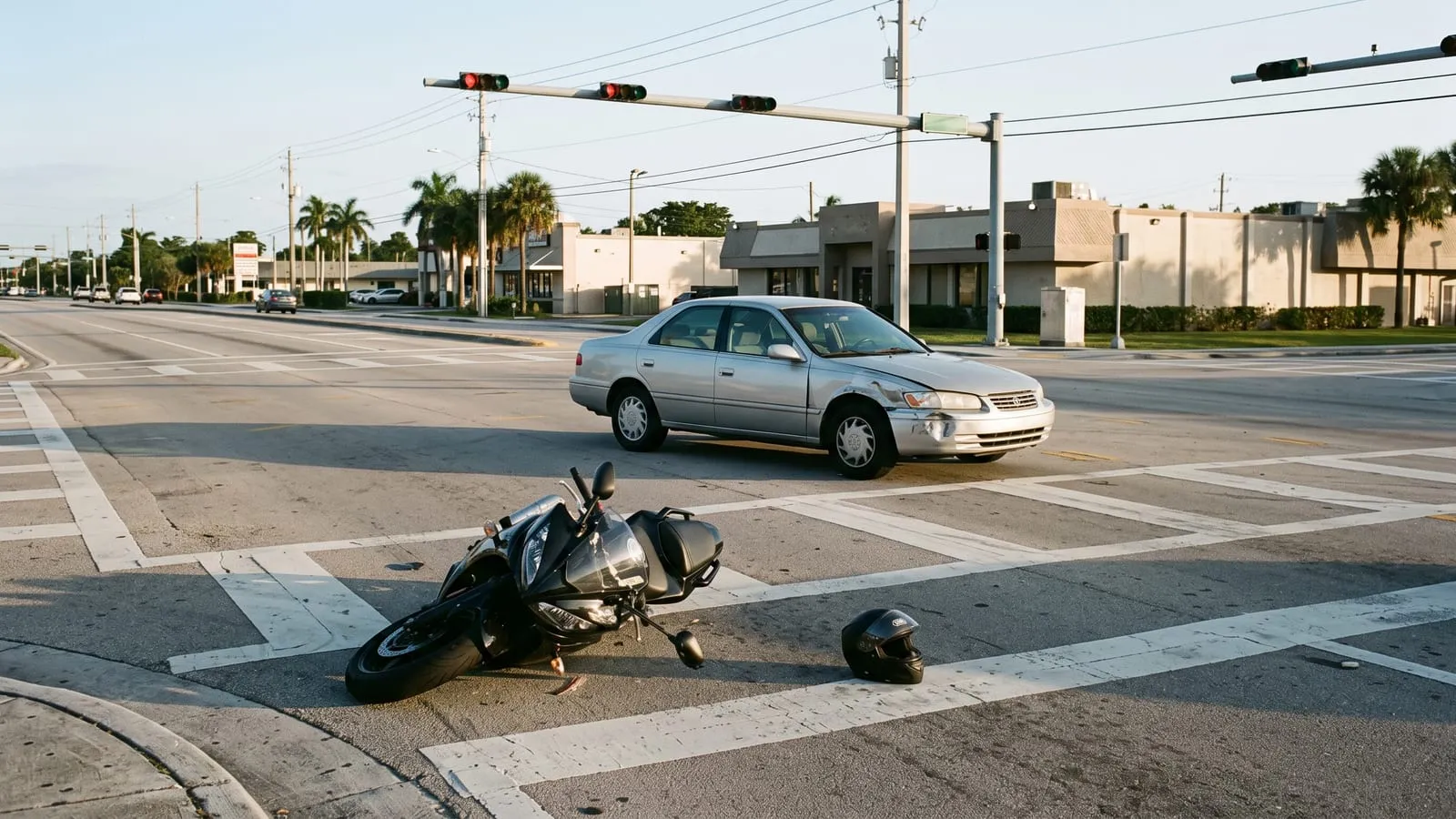
If PIP is out, where does the money come from?
Riders skip the first layer that car occupants get, so it helps to know what replaces it and when each source pays.
- Your health insurance, which can cover emergency care and treatment while the claim is pending.
- Medical payments (MedPay) coverage, if you bought it on your motorcycle policy.
- Doctors who treat under a letter of protection, meaning they agree to be paid out of the settlement or verdict instead of up front.
- The at-fault driver’s bodily injury (BI) liability coverage, which pays when the case settles or a jury decides. Florida does not require most drivers to carry it, so many of the cars on Broward roads have none.
- Your own uninsured motorist (UM) coverage, on the bike policy, on your car policy, or on a policy of a relative you live with. When the driver has no BI coverage or too little, UM is often where the real recovery comes from.
Is pain and suffering easier to claim on a motorcycle?
In one important way, yes. A car occupant has to show a permanent injury, significant permanent scarring, or death before suing the other driver for pain and suffering, because of the threshold in Fla. Stat. § 627.737. That threshold belongs to the no-fault system. Since motorcycles are outside that system, an injured rider can claim pain, suffering, and loss of enjoyment of life for any injury the driver caused, including one that eventually heals.
That does not make every claim large. The practical ceiling is the insurance available, which is why Wolfson & Leon reads every policy in your household on the first call.
Where do riders get hurt around Fort Lauderdale?
A lot of Broward riding is recreational, and much of it happens on roads crowded with people who are not watching for motorcycles. SR A1A along Fort Lauderdale Beach mixes riders with drivers hunting for parking, opening doors, and pulling out of hotel driveways. Las Olas Blvd and the 17th Street Causeway draw weekend traffic, and the drawbridges over the New River and the Intracoastal stop traffic abruptly when a span goes up, which is when a rider gets hit from behind.
Commuting riders face different risks: merges at the I-95/I-595 interchange, high speeds on the Sawgrass Expressway and Florida’s Turnpike, and the long signalized stretches of US 1 / Federal Highway, University Drive, and State Road 7 / US 441, where left-turning drivers cut across oncoming lanes. In winter, visitors in rental cars and seasonal residents unfamiliar with the roads add hesitation and sudden turns. Crashes on the interstates and toll roads are usually reported by the Florida Highway Patrol; on city streets it is the Fort Lauderdale Police Department, the Broward Sheriff’s Office, or the local city police.
The driver says, “I never saw the motorcycle.” Does that help them?
No. The most common motorcycle collision is a car turning left across the rider’s path at an intersection or driveway. Florida law requires a driver turning left to yield to oncoming traffic that is close enough to be an immediate hazard (Fla. Stat. § 316.122). A driver who says they did not see an oncoming motorcycle is describing a failure to look properly, not an excuse.
These cases still come down to proof, because the driver’s account and the rider’s are usually far apart. Wolfson & Leon builds the case from the crash report, independent witnesses, traffic and business cameras, the damage to both vehicles, and, in serious cases, a reconstruction of speed and sight lines.
What will the insurance company try to blame on me?
Expect the driver’s insurer to look for anything that shifts fault to the rider. Under Fla. Stat. § 768.81, any share of fault assigned to you reduces your recovery, and more than 50% ends it. The usual arguments are these:
- No helmet. Riders 21 and older may legally ride without one if they carry at least $10,000 in medical benefits coverage (Fla. Stat. § 316.211(3)(b)). Riding legally without a helmet is not negligence by itself, but the insurer will argue a head injury would have been less serious with one. That argument can reduce the head-injury portion of the claim; it has nothing to do with a broken leg or a shoulder injury. Eye protection is required for every rider regardless of age.
- Speed. Going a few miles over the limit may shave a percentage off, but a driver who turns left in front of a motorcycle is usually assigned most of the fault.
- Lane splitting. Riding between lanes of traffic is illegal in Florida (Fla. Stat. § 316.209(3)), so the insurer will look closely at your lane position in stopped traffic.
- Licensing. Florida requires a motorcycle endorsement to ride (Fla. Stat. § 322.12(5)), and the insurer will ask whether you had one.
What should I do in the hours and days after the crash?
Get examined right away, even if you were able to ride home. Broward Health Medical Center on S Andrews Ave and Memorial Regional Hospital in Hollywood are Level I trauma centers, and urgent care is better than nothing. Leave your helmet, jacket, gloves, and the motorcycle as they are; do not repair, clean, or throw them away, because they show where and how hard you were hit. Photograph the scene, the car, and its plate, and collect the names and phone numbers of anyone who stopped. Then let a lawyer handle the driver’s insurer.
The lawsuit deadline is the same as for other Florida negligence claims: two years from the crash, for crashes on or after March 24, 2023 (Fla. Stat. § 95.11).
What can an injured rider recover?
A rider can claim medical bills, lost income, reduced future earning ability, and pain and suffering from the driver who caused the crash, and because the no-fault threshold in Fla. Stat. § 627.737 does not apply, that last category is available for any injury, not only a permanent one. Damage to the motorcycle, helmet, and riding gear is a separate property claim.
The limit in most cases is not the law but the coverage. Florida does not require most drivers to carry bodily injury liability insurance, so the at-fault driver may have little or none, and the outcome often depends on uninsured motorist coverage on your own policies. That is why the first call with Wolfson & Leon includes a review of every policy in your household.
What mistakes hurt a motorcycle claim?
- Fixing the bike or tossing the helmet. Scuffs, dents, and cracks show the angle and force of the impact; keep everything as it is.
- Answering questions about your helmet or speed on a recorded call with the driver’s insurer.
- Leaving the scene without witness names. The driver’s story will not match yours, and an independent witness often settles it.
- Riding home instead of going to the ER. Adrenaline masks injuries, and the delay becomes the insurer’s argument that you were not badly hurt.
- Giving up because the driver had no insurance, before every household policy has been checked for UM coverage.
- Waiting until the season is over. Riders hurt in winter traffic sometimes put off the call for months, and by then the camera footage is gone.
Key facts
- Motorcycles fall outside Florida’s no-fault system, so riders have no PIP benefits. Source: Fla. Stat. § 627.732(3), § 627.733
- A rider 21 or older may ride without a helmet with at least $10,000 in medical benefits coverage; eye protection is required for all riders. Source: Fla. Stat. § 316.211
- A left-turning driver has to yield to oncoming traffic close enough to be an immediate hazard. Source: Fla. Stat. § 316.122
- Riding a motorcycle between lanes of traffic is prohibited in Florida. Source: Fla. Stat. § 316.209(3)
- Riding in Florida requires a motorcycle endorsement on your driver license. Source: Fla. Stat. § 322.12(5)
- Negligence suits over crashes on or after March 24, 2023 generally must be filed within two years. Source: Fla. Stat. § 95.11
Frequently asked questions
The driver who hit me has no bodily injury coverage. Am I out of luck?
Not necessarily. Look for uninsured motorist coverage on every policy in your household: the motorcycle policy, any car policy, and policies of relatives you live with. UM coverage stands in for the driver who should have been insured. Wolfson & Leon goes through all of them on the first call.
My injuries will heal. Can I still claim pain and suffering?
Yes. The permanent-injury requirement in Fla. Stat. § 627.737 applies to claims inside the no-fault system, and motorcycles are outside it. A rider can claim pain and suffering for any injury the at-fault driver caused, temporary or permanent.
I was riding without a helmet. Do I still have a case?
Yes. If you were 21 or older and had at least $10,000 in medical benefits coverage, riding without a helmet was legal. The insurer may argue the helmet would have reduced a head injury, which can affect how much you recover for that injury, but it does not take away your right to bring the claim.
I was going a little fast. Does that sink the claim?
Usually not. Florida reduces your recovery by your percentage of fault and bars it only if you were more than 50% at fault. When a driver turns left across a motorcycle’s path, that driver typically carries most of the blame even if the rider was over the limit.
How soon should I call a lawyer after a motorcycle crash?
As soon as you have medical care in place. Witnesses scatter, camera footage along A1A and the main corridors is often recorded over within weeks, and the driver’s insurer starts building its version right away. The lawsuit deadline is two years for crashes on or after March 24, 2023, but the evidence will not wait that long.
What happens when you call
Someone at the firm picks up
Call (754) 305-0820 day or night and you reach a member of the team, who can speak with you in Spanish if that is easier. After hours, we take your name and number and an attorney calls you back that morning.
A short conversation about the accident
We will ask for the date and place, whether a doctor has seen you, whether police wrote a report, and whether an insurance company has contacted you. It usually takes a quarter of an hour, and you do not need to find any documents first.
A straight answer, even if it is not the one you hoped for
If your case is one we can take, we walk you through what comes next and what to avoid for now, such as giving a recorded statement. If it is not, we say so plainly and point you to someone who may help.
Nothing to pay up front
If you decide to work with us, the fee is a percentage of whatever is recovered, set out in writing before you sign. No recovery means no fee. If you cannot get to downtown Fort Lauderdale, we come to your home or the hospital.
Nothing has been published on this topic so far. Call the office and an attorney can answer your question.