
Hit by a Brightline train or hurt at a rail crossing in downtown Fort Lauderdale: who can be responsible?
If you were hit by a Brightline train or hurt at a rail crossing in downtown Fort Lauderdale, responsibility depends on what went wrong, and more than one party can share it: the train operator, whoever owns or maintains the tracks, gates, and signals, a driver who caused the collision, or a public agency that controls the street. Florida's comparative fault rule lets you recover even if you were partly at fault, as long as your share is not more than 50 percent. The evidence that answers the question, such as video and signal records, is controlled by others and should be preserved in writing right away.
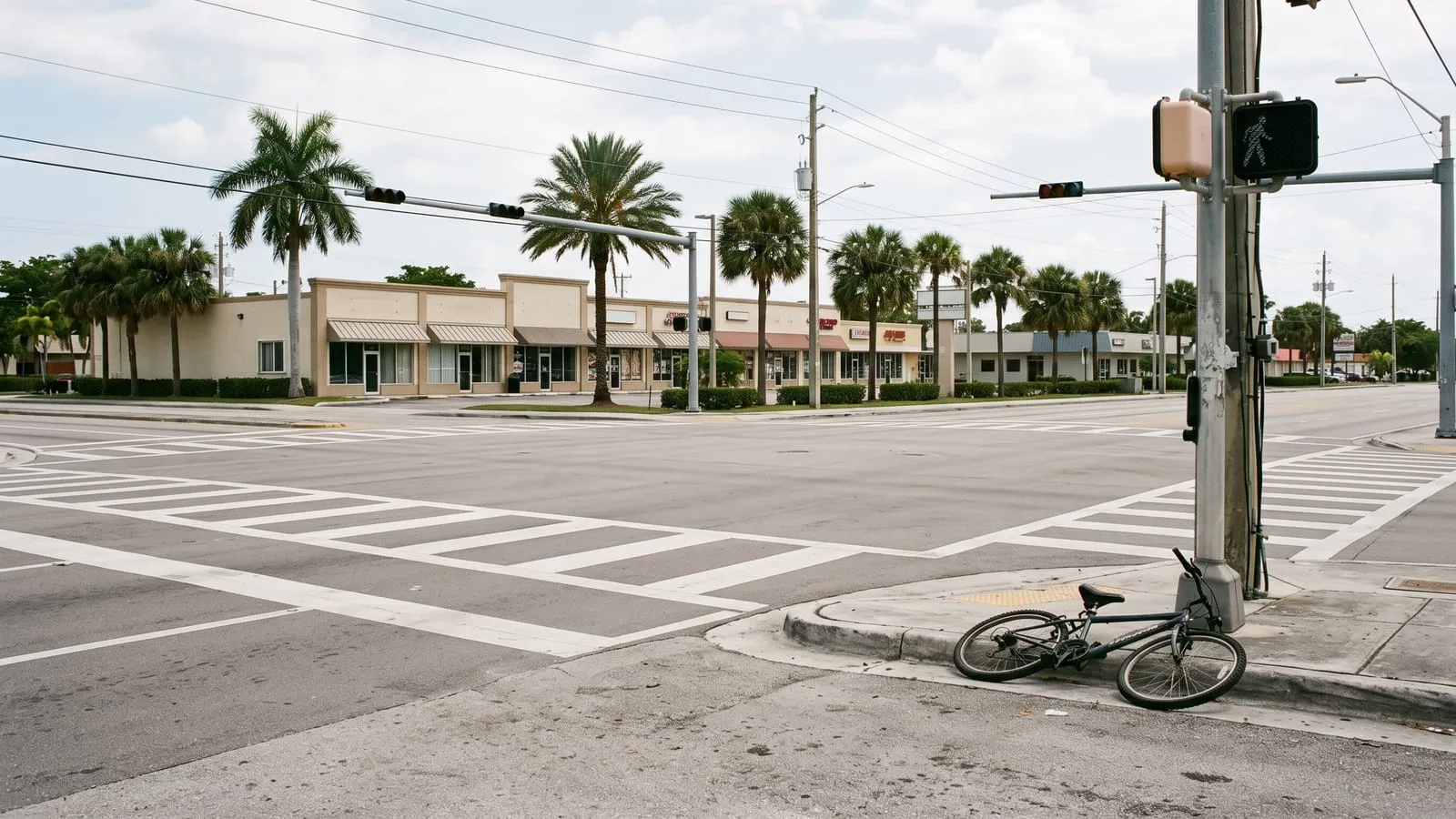
Brightline runs private passenger trains through the middle of Fort Lauderdale, with a station downtown. Its trains use the Florida East Coast tracks, which cross street after street on their way north and south through the city. Tri-Rail, the commuter line, runs on separate tracks farther west. Anyone who walks, bikes, or drives downtown crosses those tracks often, usually without a second thought.
When someone is hurt at one of those crossings, the questions are different from an ordinary car crash. The train cannot swerve, the crossing equipment belongs to someone, and the street around it belongs to someone else. This article explains, in general terms, who can be responsible and what evidence matters. It is not a comment on any company’s safety record; every case turns on its own facts.
Who can be responsible for a train or crossing injury?
More than one party is often involved, and their responsibilities overlap. Depending on the facts, a claim may look at:
- The train operator, for how the train was run: speed, lookout, horn, and braking.
- Whoever owns or maintains the tracks and the crossing equipment, for gates, lights, bells, and the condition of the crossing surface. This is not always the same company that runs the passenger trains.
- A driver, if a car pushed someone onto the tracks, stopped on them, or caused a chain-reaction crash near a crossing.
- A public agency, if the claim involves the city or county street, sidewalk, traffic signal, or signage around the crossing. Claims against public bodies require written notice to the agency before suit (Fla. Stat. § 768.28(6)) and have statutory damage limits.
- Contractors working on the tracks, the crossing, or the road nearby.
Identifying the right parties early matters, because each one has its own insurer, its own records, and sometimes its own notice requirements.
What if I was partly at fault?
That is the first argument you should expect. The defense will often say the person on the tracks ignored the gates, wore headphones, or was in a place they should not have been. Sometimes that is true, sometimes partly true, and sometimes it is not true at all.
Florida law does not make fault all-or-nothing. Under Fla. Stat. § 768.81(6), your damages are reduced by your share of fault, and you are barred only if that share is more than 50 percent. So the real questions are factual: Were the gates and lights working? When did they activate? Was the horn sounded? Was the crossing surface in good repair? Was the sidewalk route around the crossing clear and marked? The answers come from records you do not have.
What evidence should be preserved, and how fast?
Treat every item below as something that could be lost or recorded over. A written preservation demand should go to each party that may hold it.
- Video. Trains may carry cameras, crossings and stations may have them, and downtown businesses and residential towers often point cameras at the street. Private systems commonly record over themselves within weeks.
- Train data. Records of speed, horn use, and braking, where the train keeps them.
- Crossing signal records. When the gates and lights activated, and any fault or maintenance history.
- Maintenance and inspection records for the crossing and the surrounding road and sidewalk.
- The police report and the names of responding officers. Inside the city that is usually the Fort Lauderdale Police Department.
- Witnesses. People waiting at the crossing, other drivers, and anyone at the station platform.
- Your own photos of the crossing, the gates, the sightlines, and your injuries, plus the clothes and shoes you wore.
What should I do in the first days?
Get medical care and keep every record. Broward Health Medical Center, at 1600 S Andrews Ave, is a Level I trauma center. If you were in a car when you were hurt, your own PIP coverage generally pays first, and the first treatment has to happen within 14 days of the crash for PIP to apply (Fla. Stat. § 627.736(1)(a)). If you were on foot or on a bike, tell us about every auto policy in your household anyway, because Florida’s PIP rules can still matter when a car was part of what happened.
Do not give a recorded statement to any insurer, including one that calls on behalf of a rail company, before you have spoken with a lawyer. And do not sign anything offered to you in the hospital.
How long do I have?
For most injury claims under Florida negligence law arising on or after March 24, 2023, the deadline to sue is two years (Fla. Stat. § 95.11). Claims against public agencies have additional notice steps that should be started well before that. In practice, the deadline that matters most is the one on the video, which may be days or weeks.
What Wolfson & Leon does after a rail crossing injury
We listen to how it happened, identify every party that may be responsible, and send written preservation demands for video, train data, and crossing records as soon as we are retained. We work with your doctors to document the injury, and if a public agency may be involved, we start the notice process early.
Our office is at 110 SE 6th St #1717, in downtown Fort Lauderdale near the Broward County Courthouse, and we can come to you if you cannot travel. Phones are answered 24 hours a day at (754) 305-0820. The first conversation is free and can be in English or Spanish, and you pay no fee unless the firm recovers money for you.
Key facts
- An injured person who is partly at fault can still recover, reduced by their share, unless that share is more than 50 percent. Source: Fla. Stat. § 768.81(6)
- Claims against a Florida city, county, or other public body require written notice to the agency before a lawsuit, and damages are capped by statute. Source: Fla. Stat. § 768.28(6)
- A negligence lawsuit over an injury on or after March 24, 2023 generally must be filed within two years. Source: Fla. Stat. § 95.11
- Drivers must use due care to avoid striking any pedestrian. Source: Fla. Stat. § 316.130(15)
Frequently asked questions
The gates were down and I went around them. Do I still have a claim?
Possibly. Going around lowered gates will be used to assign you a large share of fault, and if that share is found to be more than 50 percent you recover nothing. But the gates, lights, horn, and train speed are still examined. Whether a claim is realistic depends on the records, and a lawyer can tell you after reviewing them.
I was in my car when a train hit it at a crossing. Does my PIP pay?
Your own PIP coverage is generally the first source for medical bills when you are hurt in a car crash in Florida, and the 14-day rule for first treatment applies. Get seen within 14 days, and tell us about every auto policy in your household.
A family member was killed at a crossing. Who can bring the claim?
In Florida a wrongful death claim is brought by the personal representative of the person's estate on behalf of the surviving family. The same evidence and deadline concerns apply. See our page on wrongful death or call to talk it through.
Will Wolfson & Leon tell me whether the train or the crossing was at fault on the first call?
No one honestly can on the first call. What we can do is explain who might be responsible based on what you describe, and start preserving the records that will answer the question.
This post is general information about Florida law and is not legal advice. Reading it does not create an attorney-client relationship with Wolfson & Leon. Each case turns on its own facts, and past results do not predict future ones. If you were injured, speak with a lawyer about your own situation.
Also available in: Versión en español